

Functional Art – Edison Illuminating Company #3
by James Howe on Oct.28, 2010, under Greenfield Village
(Nikon D700, 70-300mm at 195mm, ISO 800, HDR – 7 exposures @ f/5.6)
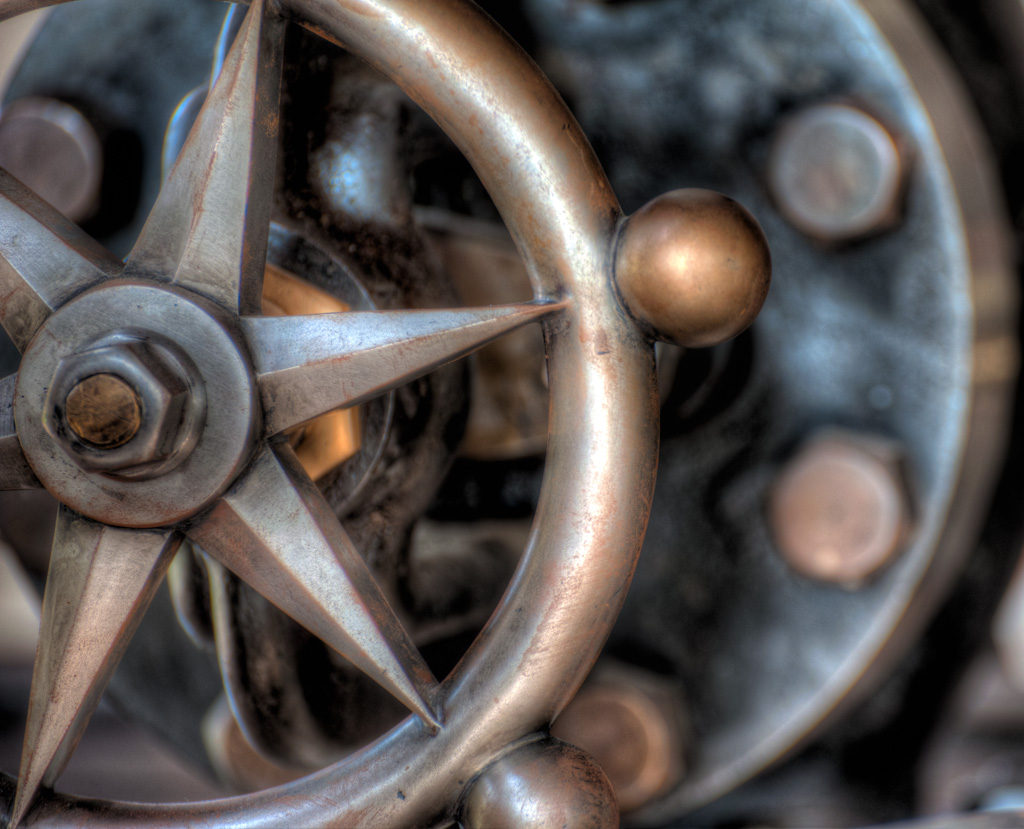
If you look through a portfolio of my images you might notice that I enjoy taking pictures of old, mechanical things. I just really like the design elements that were often used in older technolgy. It seemed as if the machine was as much art as it was functional. I think this picture from the Edison Illuminating Company building at Greenfield Village is a good example. The picture is a crank wheel attached to an electric generator. I believe this particular generator came from Edison’s power plant located on Pearl Street in New York City. The wheel serves a simple purpose, to turn something, and it could have been made with simple spokes, but this one used spokes which create a star pattern which caught my eye as I was looking for elements to shoot inside the station.
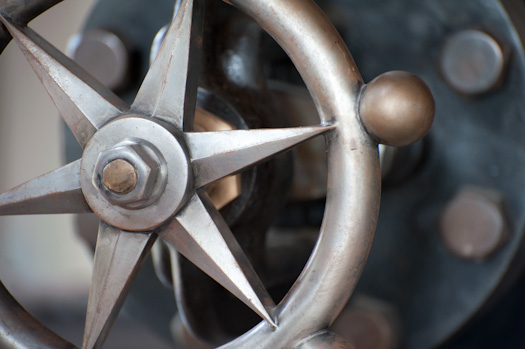
The image was created from 7 exposures using the tone mapping capabilities of Photomatix. After getting the basic look, I was able to bring out additional detail by using Topaz Adjust. The combination of the two really brings out the details in the metal. Compare the HDR to one of the single exposures below. While I probably could have used Adjust on just this one image and gotten good results, I think starting with the HDR image created a better image.
Comments or thoughts?
Copyright © 2010 James W. Howe – All rights reserved.
Low Power – Edison Illuminating Company #2
by James Howe on Oct.27, 2010, under Greenfield Village

(Nikon D700, 70-300 at 300mm, ISO 800, Exposure 1/125 sec @ f/5.6)
In yesterday’s post I showed the exterior of the Edison Illuminating Company building located inside Greenfield Village. This shot comes from the interior. Edison’s power plants produced DC power, and the power wasn’t very strong and didn’t transmit well over long distances. The further you were away from the power plant, the less power you got. The light bulbs in the building at Greenfield village run at about 40 watts, which is about the intensity of light you would have received from that plant if you were nearby. Of course, the bulbs actually lasted a long time at that power.
This image has had no special processing other than some minor sharpening. I used my 70-300 zoom at a relatively wide aperture to create the dark and blurry background.
Comments?
Copyright © 2010 James W. Howe – All rights reserved.
Edison Illuminating Company #1
by James Howe on Oct.25, 2010, under HDR
(Nikon D700, 16mm fisheye, ISO 800, 7 exposure HDR @ f/16)
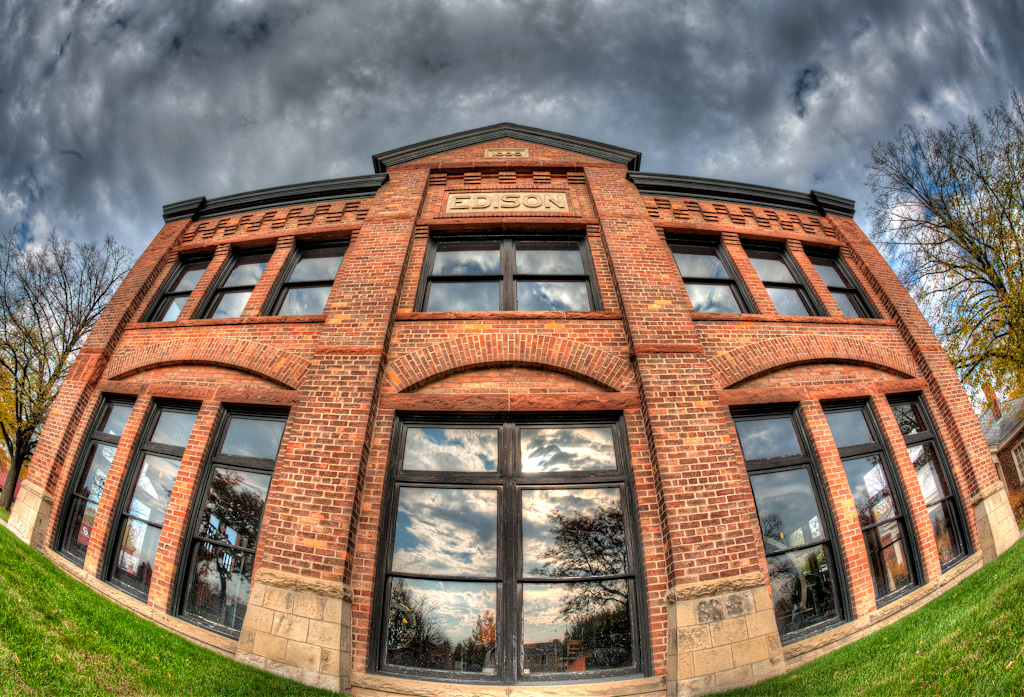
I’ve only got a couple more days before I have to send my lens rental back so I took advantage of the wonderful weather we had this weekend to once again visit Greenfield Village in Dearborn, Michigan. The day started out somewhat cloudy, but the temperature was pleasant and as the afternoon wore on, the clouds moved on. As I was walking by this building I noticed that the clouds were starting to break up and make some interesting formations. The sun was also getting lower in the sky and was adding some additional warmth to the building. I had been shooting with a longer lens, but I decided to switch back to the fisheye to see what I might be able to capture. I had my tripod with me so I decided to shoot some brackets for an HDR image. In order to make this shot, I had to crouch down very low to the ground and try to get everything lined up. I could have backed up, but I wanted the closer shot. Other than HDR processing using Photomatix, the picture is pretty much as the camera took it. I cropped just a bit from the sides, but nothing significant.
The building itself is a one-quarter replica of the Edison Illuminating Company’s Station A, the first power plant in the city of Detroit. Henry Ford worked at the Edison Illumination Company as a steam engineer eventually rising to chief engineer for this plant in 1893. This building contains some very cool generators, including one generator which came from the Edison plant located on Pearl Street in Manhattan. I was told that for a while this plant actually provided some power to the museum, but years ago the government deemed the operation unsafe (I don’t know the reason) and the steam engine and generators no longer run. It’s a shame because it would be really cool to see these things run, if only as a demonstration.
Comments?
Copyright © 2010 James W. Howe – All rights reserved.
Wider is Better
by James Howe on Oct.23, 2010, under Ann Arbor

(Nikon D700, 16mm, ISO 200, Exposure 1/30th sec @f/8.0)
One of the amazing things about the 16mm fisheye on my D700 is just how wide an image you can get. The D700 viewfinder does not show a 100% view and I was surprised when I was looking at my fisheye shots at just how much more information I had on the edges that what I saw in the frame. In the shot above, however, this wasn’t the case. The main subject of this shot is a mural painted on the wall of a building in Ann Arbor, Michigan. The mural was originally done in 1984 and the original artist was just in town to touch it up. Originally there was a bookstore located in the space above the mural, but has since moved to a different location. The mural depicts Woody Allen, Edgar Allen Poe, Herman Hesse, Franz Kafka, and Anaïs Nin. The amusing thing about this shot is the woman on the left. I was taking a straight-on shot of the mural and I saw this woman walk up and stop. Obviously she didn’t want to walk in front of my picture. What she didn’t know is that with the wide angle view of the fisheye, she was actually in the shot. Not a problem, however, since I think she adds an additional element of interest to the image.
Processing consisted of using a few layers of Nik’s Silver Efex Pro, each layer performing some part of the transition from color to black and white. When I did the conversion, I wanted to make sure that I kept some separation in the painted flower bed. A simple conversion made all of the flowers look the same. I used 3 or 4 layers to control each layer of flowers and to add some additional ‘structure’ in places. I also used a couple of simple curves layers to darken some areas and add some contrast. Compare with the color shot seen below.

As always I’m interested in your comments and feedback.
Copyright © 2010 James W. Howe – All rights reserved.
Arcadian Antiques – Nickels Arcade
by James Howe on Oct.22, 2010, under Architecture
(Nikon D700, 16mm fisheye, ISO 1000, Exposure 1/30 sec @ f/8.0)
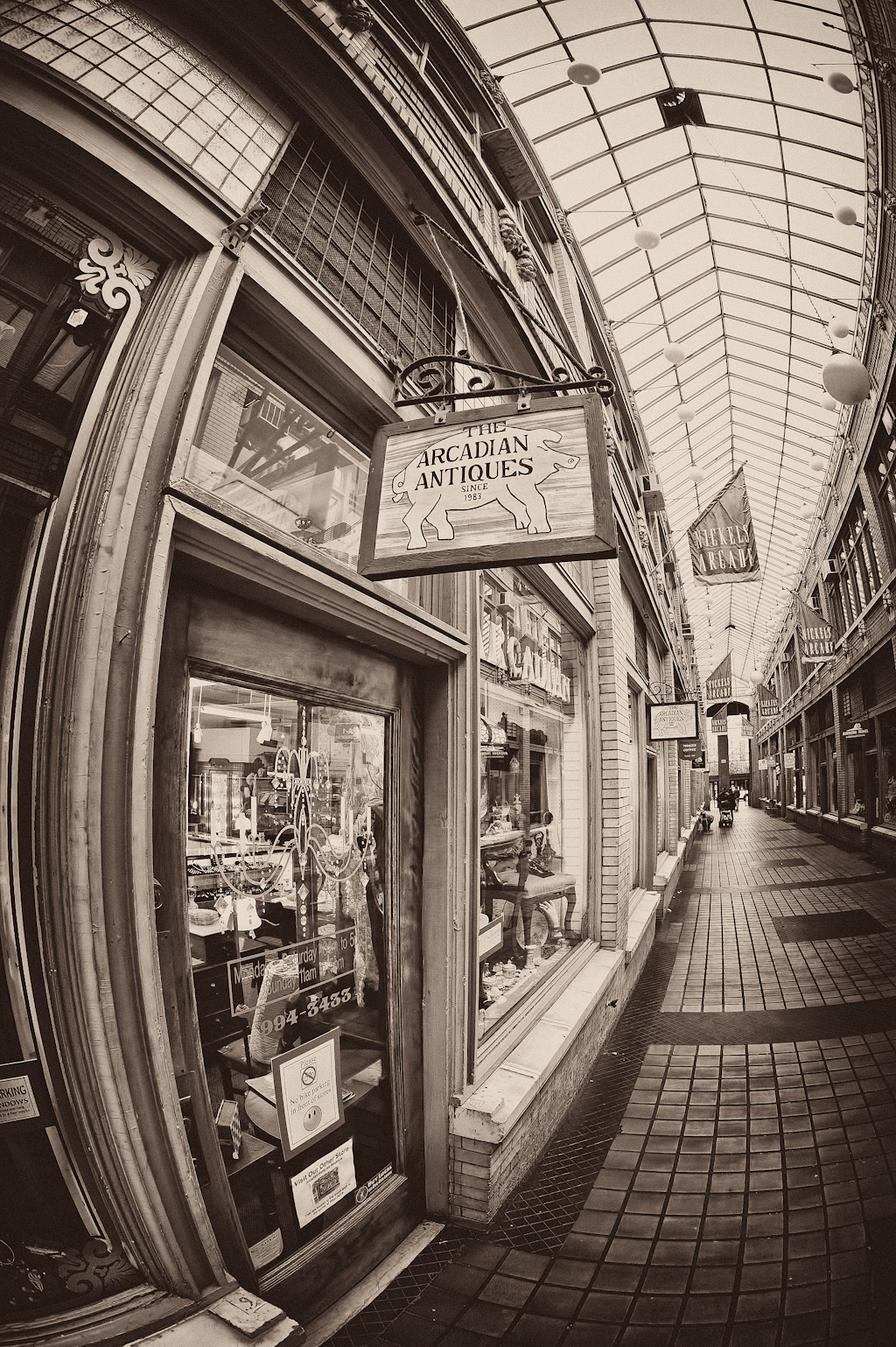
I’ve been feeling someone uninspired in my photography of late, getting bored with shooting similar subjects. I really enjoy shooting with a wide angle lens, but I typically use the wide angle for architecture shots to give me enough material to create reasonably straight lines. However, I’ve always enjoyed seeing images of architecture and other subjects which have been shot with a fisheye lens. So, just for fun and to mix things up a bit, I decided to rent the Nikkor 16mm fisheye for use on my D700. I went out for a walk around town late yesterday just to see what sort of interesting images I might be able to create with this lens. I managed to get a few that I liked and I enjoyed shooting with this lens.
The image above shows ‘The Arcadian Antiques’ a store located in Nickels Arcade located in Ann Arbor, Michigan next to the campus of the University of Michigan. The Arcade is an interesting structure, basically a long covered alleyway between two buildings. It’s an interesting place to photograph with lots of different subjects. For this shot I really wanted to make use of the curved distortion created by the fisheye. I got close to one wall and I liked the way the lens curved the doorframe of the shop and also added a bit of an arc to the ceiling and walkway. For processing, I used Nik’s Silver Efex Pro to convert the color image to black & white. I started with the ‘Antique’ preset and made some further adjustments. The preset created the toning and the vignetting which I thought worked well with the subject (an Antiques store) as well as the curved nature of the shot. As always, the original out of camera shot is shown below.

Comments?
Copyright © 2010 James W. Howe – All rights reserved.